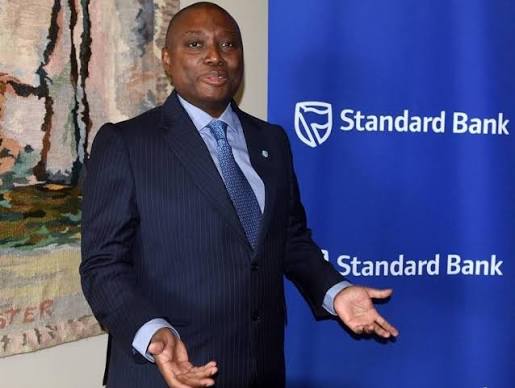
Standard Bank Chief Executive Sim Tshabalala says African governments pay about two percentage points more to borrow than peers because markets misjudge the continent’s risk.
Tshabalala believes that global markets overstate the risk of investing in Africa, and the continent pays for it through higher borrowing costs.
Between 2004 and 2021, sub-Saharan African governments paid coupons on international bonds that averaged about two percentage points more than those of issuers in other regions, Tshabalala wrote. That premium filters through to banks, companies and projects across the continent, raising their cost of funding as well.
Ratings gap
Standard Bank’s own analysis suggests that credit rating companies grade sub-Saharan sovereigns as much as four notches below what their economic fundamentals imply, he said. The default rates implied by those ratings are well above the defaults African issuers have actually recorded.
Tshabalala pointed to infrastructure as an example. Data from the Global Emerging Markets Risk Database show that losses on defaulted infrastructure projects are lowest in sub-Saharan Africa, he wrote, and after five years the default rates on project-finance loans can fall below those of investment-grade companies. He asked regulators to set capital requirements on observed losses.
Bank rules also force lenders to hold more capital against loans to small businesses than the risk warrants, pushing up interest rates for companies that create more than two-thirds of jobs in emerging and developing economies, he wrote. Trade finance, which is short-term and has historically defaulted at rates below 0.5%, should also be reassessed, he said, a call made in the leaders’ statement from the B20 business summit in Washington.
“Borrowers must earn their creditworthiness,” he wrote, adding that markets must then recognize it. “That is what Africa asks: not a favour, but an accurate reading.”
Growth case
Tshabalala said sub-Saharan Africa is expected to grow 4.5% this year and next, has the youngest and fastest-growing population of any region and holds minerals needed for the energy transition and artificial intelligence. He cited Alexander Hamilton’s 1790 plan to honor U.S. war debts, which lifted American bonds from 20 to 25 cents on the dollar to above face value within a year, as proof that a borrower’s standing can change quickly.
More than 500 U.S. companies operate in South Africa, he said, and Africa should help write the rules on trade, capital and payments that are now being reshaped.
Africa’s biggest lender
Tshabalala has led Standard Bank since 2013, first as joint CEO and then on his own from 2018. Johannesburg-based Standard Bank is Africa’s largest lender by assets and operates in 20 countries on the continent. China’s Industrial and Commercial Bank of China Ltd. owns about a fifth of the group.
Tshabalala was a leading voice at the 2025 B20, the business arm of the Group of 20, when South Africa hosted the G20.